Preventive medicine clinicLondon
Vellacott.
Website for a preventive medicine clinic in Marylebone, London. In a sector where promising youth and a longer life is common, the site needed to explain an annual medical program with evidence, without promising results, and lead people to the first appointment.
Case study
The challenge.
Longevity clinics tend to sell on quantity: more than a hundred biomarkers, full-body scans, invitations to “live longer”. In the UK, the advertising code (CAP, section 12) requires evidence for every health claim, and the Royal College of Radiologists recommends imaging only to investigate symptoms. The audience, aged 40 to 65, feels well and wants to understand their own risks. The site needed to be calm, precise and clear about what the clinic does not do.
- 01 Claims need a sourceEvery health statement needed evidence; promising rejuvenation or disease prevention without proof breaches the British code.
- 02 Sensitive health dataQuestions about sleep or family history generate special category data under the UK GDPR and require explicit consent.
- 03 Too many testsThe market sells test volume; the clinic needed to explain why it measures less and what it leaves out.
- 04 Trust without social proofWith no testimonials, patient numbers or badges, trust had to come from the named doctor and the method.
Flowt Method
The diagnosis.
The site explains an annual medical program with evidence and full pricing, without promising results, and guides the person to the initial assessment.
- First screen and value propositionIt says what it is and where (preventive medicine in Marylebone), who it's for (adults who feel well), the differentiator (same measures, same doctor, 12 months later) and shows the assessment button.
- SpeedHbA1c chart in custom SVG, fonts served by the site and photos in AVIF and WebP in multiple widths; the layout barely shifts while loading (CLS 0.001).
- Verifiable accessibilityLighthouse 100 and axe with no violations.
- Path to the main action“Begin the assessment” is on the first screen: 1 tap to the assessment, 12 to book the time slot.
- Price and scopeTotal price of each option (£1,450 for the baseline; £4,800 per year or £400 per month), what is and isn't included, VAT exemption, 14-day cancellation and an invoice for insurance.
- Safe bookingSimulated booking after the assessment, UK GDPR art. 9 consent before the first question, 999 and NHS 111 signposted and a summary of what the first appointment covers.
See the full analysis
All 13 criteria, with the evidence for each point: what meets the criterion, what partly meets it and what depends on a real company. Because the brand is a concept, there is no "before" and no total score.
Being found
Title and description on each page, one H1, MedicalClinic, Physician and FAQPage JSON-LD, prices in text. Partial: noindex on purpose, no third-party mentions, no full address and no opening hours.
Concept brand, no real reviews. In a real project, volume, recency and responses are measured before and after on Google, Doctify and Trustpilot.
Being chosen
It says what it is and where (preventive medicine in Marylebone), who it's for (adults who feel well), the differentiator (same measures, same doctor, 12 months later) and shows the assessment button.
6 of 6 checks
Two doctors with name, role, background and a GMC number field, plus the CQC panel. A real clinic would add the actual numbers, the CQC rating and the full address, which the site omits.
There are no external channels to compare. Within the site, the number and length of visits and the program timelines match across the home page, the Programme page and the assessment summary.
Both doctors have a specialty and a GMC number field, and the footer reproduces the CQC panel required by Regulation 20A. Partial: GMC numbers and rating are examples, and cqc.org.uk appears without a link.
Total price of each option (£1,450 for the baseline; £4,800 per year or £400 per month), what is and isn't included, VAT exemption, 14-day cancellation and an invoice for insurance.
No promise of a cure or a longer life, and the site says it makes none. But the “What we measure” table includes health statements without the source on the page itself.
4 statements without a source on the page
Being contacted
HbA1c chart in custom SVG, fonts served by the site and photos in AVIF and WebP in multiple widths; the layout barely shifts while loading (CLS 0.001).
Lighthouse 100 on mobile · LCP 1.4 s
Lighthouse 100 and axe with no violations. The entire assessment works with the keyboard alone: focus moves to the heading of each step and a live region announces “Question 2 of 4”.
axe: 0 violations
No trackers or cookies, and explicit consent before the health questions. No analytics installed and no dedicated privacy notice, which the UK GDPR requires of a real clinic.
“Begin the assessment” is on the first screen: 1 tap to the assessment, 12 to book the time slot. The end explains that a real clinic would send a confirmation and a short questionnaire.
1 tap to the assessment · 12 to the time slot
Simulated booking after the assessment, UK GDPR art. 9 consent before the first question, 999 and NHS 111 signposted and a summary of what the first appointment covers.
simulated
Industry obligationsThe footer of every page reproduces the CQC panel with the rating left blank and the explanation, the GMC numbers appear as examples, and 999 and NHS 111 are signposted.
In a real project, each criterion is measured before and after, with the same yardstick and evidence for each point. There is no score: what you see is how many points remain open.
Strategy
Strategy and site map.
The home page presents the program as a twelve-month timeline: two baseline visits, a review with the doctor, three follow-ups and the same measures at the end, read by the same doctor. Each test appears in a table with the reason it is there, alongside what the clinic does not offer and why. An evidence scale (recommended, worth discussing, not offered) shows how the plan is put together. Conversion happens through a four-question assessment that ends with the summary of the first appointment and the choice of a time slot.
01Home
- Opening with the program in numbers
- Annual program and chart
- What we measure and what we don't offer
- Doctors
- How we read the evidence
- The clinic in Marylebone
- Call to action for the assessment
02Programme
- Opening
- The twelve months, step by step
- What is and isn't included
- Pricing
- Frequently asked questions
- Call to action for the assessment
03Assessment
- Consent
- Sleep
- Energy
- Family history
- Priority
- Appointment summary
- Hours
- Confirmation
Visual system
Typography, color and rhythm.
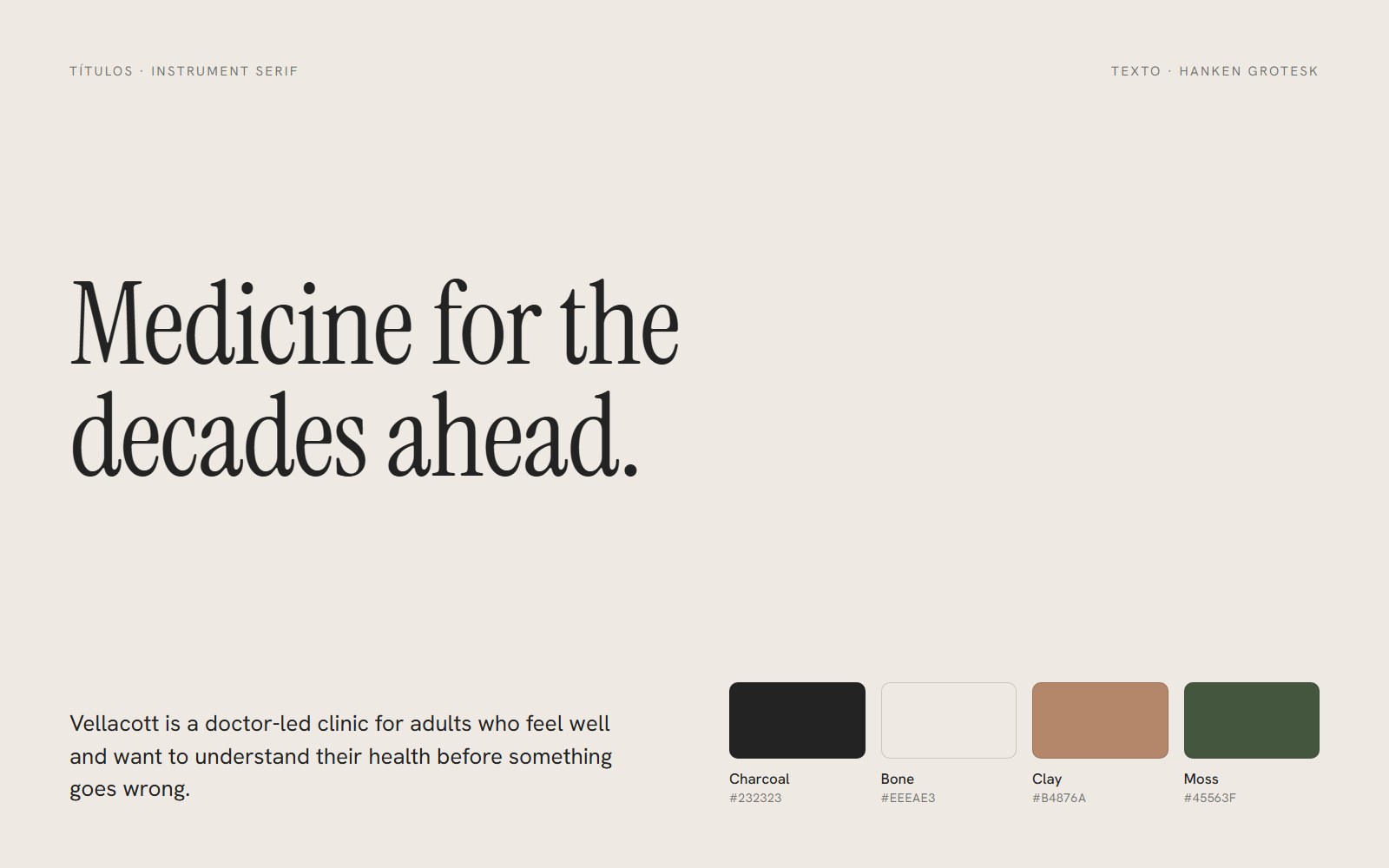
Instrument Serif, condensed and light, gives the headings an editorial tone, with clay italics only on the word the sentence stresses; Hanken Grotesk carries tables and long explanations. Bone, graphite, clay and moss replace hospital blue and evoke the interior of a Georgian townhouse. The pace is calm: native scrolling, photos that appear slowly and no animation competing with the medical information for attention.
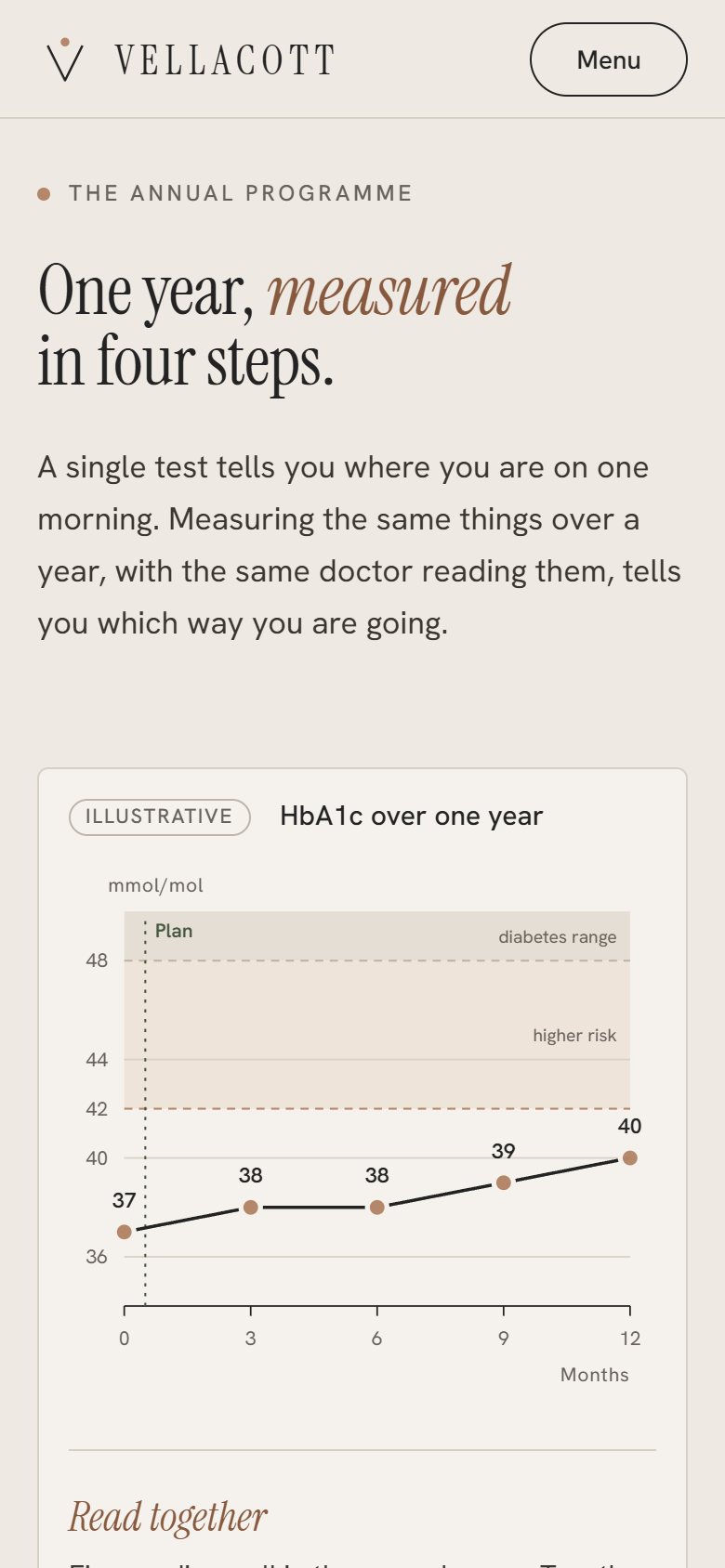
- Illustrative HbA1c chart
- What-we-measure table
- Evidence scale
- Assessment progress line
- Footer regulatory panel
Signature moment
Assessment before the appointment.
After explicit consent, four questions appear one per screen: sleep, energy, family history and priority. The answers define what goes into the first appointment summary, such as sleep questionnaires or a cardiologist review. At the end, the person reviews everything, can change any answer and chooses a time slot. Nothing is stored or sent. The format follows the GOV.UK question pattern, familiar to anyone who uses British public services.
On mobile
Made for the small screen.
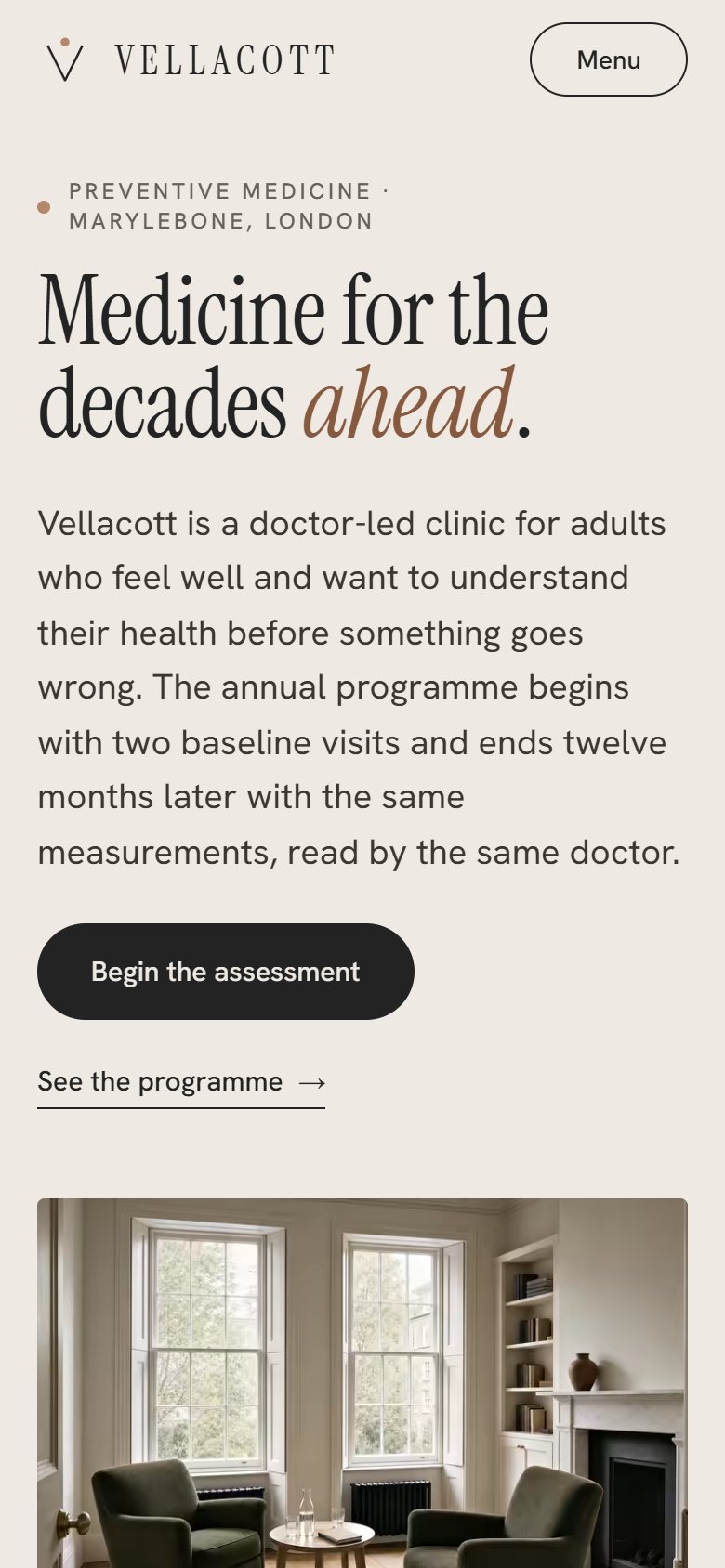
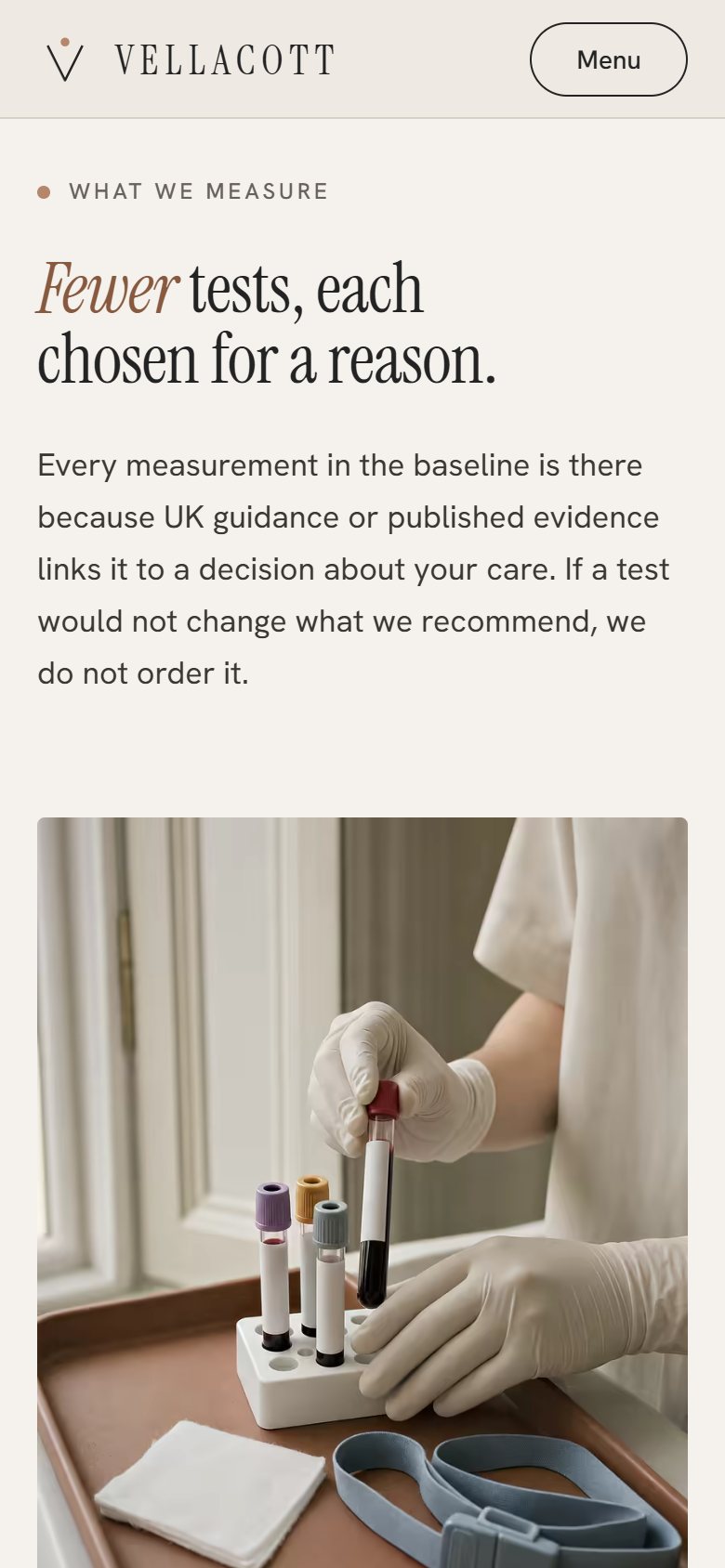
Three screens of the site on a 390 px wide phone, the most common width today.
Receipts
Measured performance.
The scores below were measured on the published site using Google Lighthouse. They are not a promise: they record the state of the site on the measurement date. Demonstrations are presented on video. Measurements record the state of the project on the indicated date.
On mobile
- Largest visible element (LCP)
- 1.4 s
- Stability (CLS)
- 0.001
- Blocking (TBT)
- 0 ms
On desktop
- Largest visible element (LCP)
- 0.5 s
- Stability (CLS)
- 0.001
- Blocking (TBT)
- 0 ms
Measured on Oct 3, 2026 with Lighthouse 13.5.0, simulated mobile and desktop. *SEO stays below 100 on purpose: the concept site carries the noindex directive, so it does not appear on Google or compete with real businesses. Accessibility was also checked with axe (zero violations), and alignment was reviewed at 7 screen widths.
Behind the scenes
Fact sheet.
- Pages
- Home, Programme, Assessment and 404 page
- Languages
- English (UK)
- Technology
- HTML, CSS and JavaScript, no framework, generated by a custom Python script
- GSAP and ScrollTrigger for the chart and the twelve-month ruler
- Native scrolling, no smoothing library
- View Transitions between pages
- SVG chart generated from the data
- AVIF photos with WebP fallback
- Fonts served by the site itself, JS minified with esbuild
- Images
- AI-generated interior photographs, with no faces or patients, processed as a single series; the HbA1c chart and the symbol were drawn in SVG.
- Accessibility
- Entire assessment operable by keyboard, focus moved to the heading of each question, step announced to screen readers, reduced-motion version and zero axe violations.
- Industry rules
- Follows the CAP Code (section 12) and the UK GDPR: every health claim has a source, consent comes before the first question, and GMC and CQC registrations appear as examples.
Start now
Let's bring your online presence up to the level of your service.
Start with the free diagnosis: we measure your online presence and show you, point by point, what to fix first.
Booking open for new projects
Tell us about your project
A few details are enough. We'll ask about the rest.